


With acid reflux, stomach contents can reach the throat or mouth, causing a sour or bitter taste, irritation and a burning or uncomfortable sensation behind the breastbone or in the throat.
When symptoms recur frequently or affect everyday life, this is reflux disease, also known as GERD or GORD. A common underlying cause is that the valve at the top of the stomach does not close tightly, which may be due to a weakened diaphragm.
Common acid reflux symptoms
Common symptoms of acid reflux include:
- A sour or bitter taste in the mouth
- Heartburn or a burning sensation in the throat or behind the breastbone
- Thick, bubbly or frothy mucus in the throat
- A dry cough and throat clearing
- Hoarseness or voice changes
- Nausea
- Pain or discomfort in the upper abdomen
- A sore throat, especially in the morning
- Breathing difficulties or asthma-like symptoms
- Bad breath
- Acid erosion of the teeth or irritation of the lining of the mouth
- Symptoms that get worse after a meal, when bending forwards or when lying down
Reflux can feel different depending on how far up stomach acid or stomach contents reach. While some people clearly feel acid coming back up and experience heartburn, others mainly have symptoms affecting the throat, voice or airways, or changes to their oral health.
Do you recognise several of these symptoms?
Because the symptoms listed above usually share the same underlying cause, many people experience several at the same time without realising that they are connected.
Thick mucus
Reflux irritates the throat lining → increased mucus production
A lump in the throat
Muscle tension in the throat → a feeling of a lump
Dry cough and throat clearing
Reflux irritates the throat and vocal cords → coughing and throat clearing
Could a hiatus hernia be behind your reflux symptoms?
Take the 3-minute self-test. No email needed – get your results straight away.
What is acid reflux?
Acid reflux means that stomach acid or stomach contents leak back up from the stomach into the oesophagus, throat or mouth. Reflux is the term for this backflow, which people often feel as acid coming back up.
What does acid reflux feel like?
You may feel stomach acid suddenly bubbling or washing back up into the oesophagus. When the backflow is more forceful, food particles or thick, bubbly mucus may also come back up towards the throat or mouth.
Because stomach acid is highly acidic, it can cause a burning, sour or irritating sensation in the throat and behind the breastbone. When stomach acid reaches the sensitive lining of the oesophagus, the airways and the vocal cords, it can also cause coughing, hoarseness, nausea, mucus in the throat or discomfort in the upper abdomen.

What causes acid reflux?
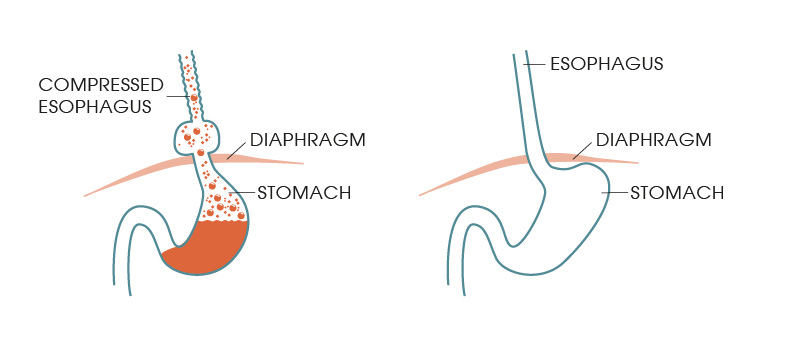
A common cause of recurring acid reflux and GERD is a hiatus hernia. This means that the diaphragm has weakened and allows the upper part of the stomach to move up into the chest. There, the stomach valve has less support and struggles to close tightly. Stomach acid or stomach contents can therefore leak back up more easily, causing acid reflux and heartburn.
The stomach valve controls the opening between the stomach and oesophagus. The diaphragm normally helps the valve close tightly, so that stomach acid and stomach contents stay in the stomach.
Read more about why a weakened diaphragm can cause acid reflux.
Who gets acid reflux?
Acid reflux can affect both children and adults, including people who are otherwise healthy. So having symptoms does not mean that you are unfit or have done anything wrong. You are not alone either – recurring acid reflux affects more than one in five people, according to estimates.
Factors that affect the diaphragm, increase pressure on the stomach or make it harder for the stomach valve to close tightly can increase the risk. These include, for example, pregnancy, an inherited susceptibility, older age, reduced muscle function, long-term illness, being severely overweight or repeated heavy physical strain.
What can make acid reflux worse?
When the diaphragm is weak, the stomach valve struggles to close tightly. Certain everyday factors can then make it easier for stomach acid or stomach contents to leak back up and worsen symptoms. Acid reflux can therefore become more noticeable with certain meals, drinks, body positions or physical strain.
Common triggers include, for example, large meals, late evening meals, lying down or bending forwards after eating, heavy lifting, coffee, alcohol, fizzy drinks, fatty or spicy foods, chocolate and citrus fruits.
Triggers vary from person to person. It can therefore help to notice what makes your own symptoms worse.
Read more about foods that can make acid reflux symptoms worse.
Acid reflux treatment
Compare different acid reflux treatment options.
TREATMENT OPTION
HOW IT WORKS
WHEN IT MAY BE SUITABLE
COMPARISON WITH IQORO
Lifestyle changes
What it does
Reduce everyday factors that can trigger or worsen symptoms. Can provide short-term relief for many people.
Best for
Mild or occasional symptoms, or alongside other treatment.
IQoro comparison
You can use IQoro alongside lifestyle changes – they address different aspects of the symptoms.
Medication (PPIs)
What it does
Reduce stomach acid production. Can effectively control acid reflux and heartburn symptoms, but do not strengthen the diaphragm.
Best for
Frequent or more severe reflux symptoms.
IQoro comparison
IQoro strengthens the weakened diaphragm – a common underlying cause of recurring acid reflux.
In our customer survey, 65–74% could reduce or stop taking reflux medicines. Always discuss medication changes with your doctor.
Neuromuscular training (IQoro)
What it does
Strengthens the diaphragm and the muscles in the swallowing chain, so that the stomach valve has better support to close tightly. Targets the underlying cause: a weakened diaphragm.
Best for
Treatment of the underlying cause and long-term improvement.
Suitable for both children and adults.
IQoro comparison
The only option in this comparison that directly trains the function of the diaphragm.
Surgery
What it does
The surgeon moves the stomach back below the diaphragm and often reinforces the mechanism that prevents acid reflux by wrapping part of the stomach around the lower end of the oesophagus and stitching it in place.
Best for
Severe or long-term reflux symptoms, for example in reflux disease (GERD), or when other treatment options do not provide enough relief.
Requires medical investigation and is not suitable for everyone.
IQoro comparison
IQoro strengthens the weakened diaphragm and trains the muscle function behind the symptoms, without surgery.
How to train with IQoro for acid reflux
Through neuromuscular training, IQoro activates and strengthens muscles along the swallowing chain from the mouth and throat down to the diaphragm. As the diaphragm gets stronger, the stomach valve has better support to close tightly, making it easier for stomach acid and stomach contents to stay in the stomach.

Step 1
Place and pull
Place IQoro inside your lips, in front of your teeth. Pull gently outwards while resisting the pull with your lips pressed tightly around the handle.
Step 2
Train for 90 seconds a day
Do 3 × 10-second pulls, three times a day. Leave at least 2 hours between training sessions.
Step 3
Symptoms improve over time
Symptoms decrease as training strengthens the muscles. Train for at least 6 months and until you have achieved your desired result, then gradually reduce your training to a maintenance level.
6-month money-back guarantee · Free delivery · CE-marked
Scientifically studied.
Clinically documented.
IQoro draws on 17 internationally published scientific studies that research teams have carried out at Swedish universities. Their expertise spans surgery, ear, nose and throat medicine, dentistry, speech and language therapy, gastroenterology and radiology. They have studied IQoro in people with hiatus hernia, reflux and swallowing difficulties.
A weakened diaphragm can affect several functions between the mouth and stomach at the same time, from how tightly the stomach valve closes to how the oesophagus works. Neuromuscular training with IQoro strengthens the diaphragm and can therefore improve several symptoms at the same time.
97
%
of study participants improved after 6-8 months of training with IQoro.
54-73
%
became symptom-free, depending on the symptom.
10
+
symptoms and functions can improve with one treatment – IQoro.
+
65
mmHg
increase in pressure in the opening of the diaphragm during IQoro training.
Reflux terminology: reflux, GERD, GORD and silent reflux (LPR)
Reflux does not feel the same for everyone. While some people mainly have heartburn and a feeling of acid coming back up, others have less specific symptoms affecting the throat, voice or airways.
We therefore use different reflux terms to describe how symptoms show up. The differences mainly concern how often symptoms recur, how far up stomach acid or stomach contents reach and where you feel symptoms most. The terms can overlap, and the same person can have symptoms associated with reflux, GERD, GORD and silent reflux (LPR – laryngopharyngeal reflux). The table below shows which symptoms go with each term.
Symptoms of reflux and silent reflux (LPR)
| SYMPTOM | Reflux (GERD, GORD) | Silent reflux (LPR) |
|---|---|---|
| Heartburn | ● | ● |
| A lump in the throat | ● | ● |
| Pain behind the breastbone | ● | |
| Difficulty swallowing | ● | |
| Thick, frothy mucus | ● | ● |
| Acid or stomach contents coming back up | ● | |
| A persistent dry cough | ● | |
| A sore throat | ● | |
| Irritation of the voice box/vocal cords | ● | |
| Hoarseness | ● | |
| WHERE? | ||
| Throat | ● | ● |
| Chest | ● | |
Reflux, GERD and GORD
When reflux symptoms recur frequently or affect everyday life, this may be called reflux disease. Internationally, people use the terms GERD and GORD, which both mean gastro-oesophageal reflux disease.
Common symptoms of reflux disease include heartburn, a feeling of acid coming back up, pain behind the breastbone and sometimes a feeling of a lump in the throat, difficulty swallowing, thick or frothy mucus and a persistent dry cough. You often feel symptoms in the chest, but you may also feel them in the throat.
The difference between GERD and GORD mainly comes down to American and British spelling. GERD stands for gastroesophageal reflux disease, whereas GORD stands for gastro-oesophageal reflux disease.
Silent reflux and LPR – when reflux affects the throat and voice
Silent reflux and LPR describe reflux symptoms that you mainly feel in the throat, voice or airways. LPR stands for laryngopharyngeal reflux and means that stomach acid or stomach contents reach high up into the throat and voice box. The voice box contains the vocal cords and helps protect the airways.
People commonly use the term silent reflux when symptoms occur without obvious heartburn or a feeling of acid coming back up. Instead, symptoms may include hoarseness, throat clearing, a feeling of a lump in the throat, thick mucus, a dry cough, a sore throat, irritation around the vocal cords and voice changes.
When to seek medical advice for acid reflux
Acid reflux is common and usually not dangerous when it happens occasionally. However, you should contact a healthcare professional if symptoms are severe, recur frequently, change in a way that worries you or affect your everyday life. They can then assess your symptoms and rule out other causes.
Recurring acid reflux often goes hand in hand with a weakened diaphragm, known as a hiatus hernia. We have therefore brought together more information about when to seek medical advice, when to seek help straight away and what examinations and investigations may involve.
Read more about when to seek medical advice for acid reflux and a suspected hiatus hernia.
You can start training with IQoro while waiting for an examination appointment, as long as you do not have any of the conditions in which you should not use IQoro. Always follow the instructions for use and contact us if you are unsure. IQoro does not replace medical investigations.
Long-term acid reflux and its complications
Acid reflux is common and usually harmless when it happens occasionally. However, with long-term or recurring reflux, stomach acid can irritate and damage the lining of the oesophagus. If the acid reaches further up, it can also affect the mouth and teeth.
Over time, this can lead to inflammation, scarring, changes to cells or acid erosion of the teeth. A healthcare professional needs to assess these complications and, if necessary, follow them up.
Inflammation of the oesophagus – oesophagitis
When stomach acid frequently leaks back up into the oesophagus, the lining can become irritated and inflamed. This is called oesophagitis, or inflammation of the oesophagus.
Oesophagitis can cause symptoms such as heartburn, pain behind the breastbone, difficulty swallowing or irritation in the throat or oesophagus. If the inflammation recurs or does not have a chance to heal, it can cause permanent changes to the lining over time.
Barrett’s oesophagus – changes to cells in the oesophagus
Barrett’s oesophagus means that long-term exposure to stomach acid has changed the lining at the lower end of the oesophagus. The cells then start to resemble the type of lining found in the intestine.
The change itself may not cause obvious symptoms, but it can mean a slightly higher risk of oesophageal cancer, known as adenocarcinoma. A healthcare professional may therefore need to monitor Barrett’s oesophagus with check-ups.
Peptic stricture – narrowing of the oesophagus
With long-term inflammation, the oesophagus can sometimes heal with scar tissue. It can then become narrower and less elastic. This is called a peptic stricture.
A peptic stricture can make it difficult to swallow, especially solid food. It may feel as though food gets stuck or stops as it moves down the oesophagus. A healthcare professional always needs to assess these symptoms.
Acid erosion of the teeth and effects on oral health
If stomach acid frequently reaches all the way up to the mouth, it can affect both the teeth and the lining of the mouth. The acidic stomach juices can gradually wear away tooth enamel and cause dental erosion, also known as acid erosion of the teeth.
The damage can develop over time, and a dentist may sometimes only notice it during an examination.
Effects on the throat, voice and airways
If stomach acid or stomach contents reach high up, they can irritate the throat, voice box and airways. Long-term reflux can therefore be associated with a chronic dry cough, throat clearing, hoarseness, inflammation of the voice box and, in some people, worsening asthma symptoms.
These symptoms can also have other causes. A healthcare professional therefore needs to assess symptoms such as a persistent cough, hoarseness or breathing difficulties.
References & sources (4)
- Hägg M, Tibbling L, Franzén T. Esophageal dysphagia and reflux symptoms before and after oral IQoro® training. World J Gastroenterol 2015; 21(24): 7558-7562
- Hägg M, Tibbling L, Franzén T. Effect of IQoro® training in hiatal hernia patients with misdirected swallowing and esophageal retention symptoms. Acta Otolaryngol. 2015 Jul;135(7):635-9.
- Kjellén G, Tibbling L. Manometric oesophageal function, acid perfusion test and symptomatology in a 55-year-old general population. Clinical Physiology. 1981; 1:405-15
- Franzén T., Tibbling L., Hägg M. Oral neuromuscular training relieves hernia-related dysphagia and GERD symptoms as effectively in obese as in non-obese patients. Acta Oto-Laryngologica. 2019