


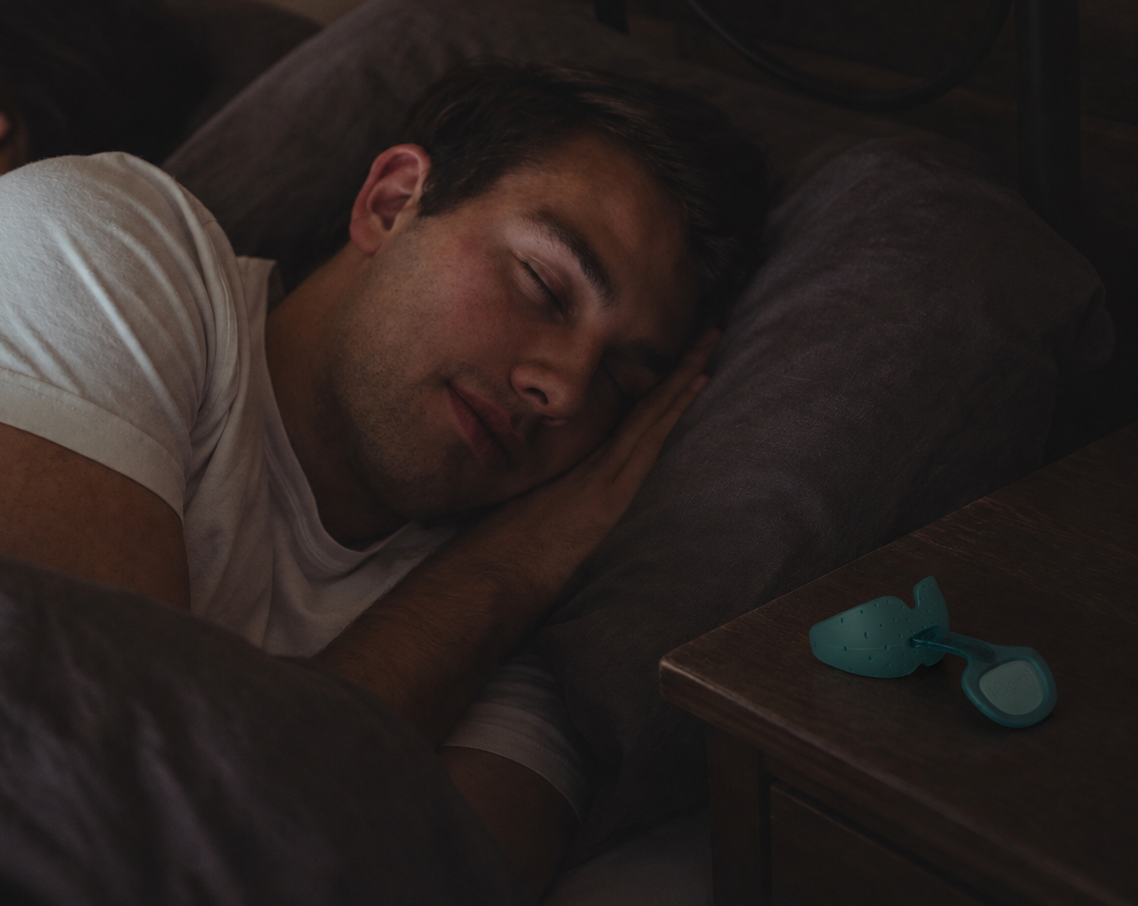
Why do you snore?
Snoring is often due to the excessive relaxation of the soft palate, which is at the back of the mouth, causing a too narrow a space for air to pass. Vibration then occurs in both the palate and the throat, and these vibrations create the snoring sounds.
Over time, problems with snoring can lead to vibrational damage in the nerves and eventually even the muscles in the throat. Interrupted sleep also results in insufficient rest for you and anyone sharing your bed, which can lead to learning difficulties.
Symptoms of snoring
How do you know if you snore? Snoring is very common and directly or indirectly affects many of us.
It’s easier to find out if you snore if you live with someone. But if you usually sleep alone, you may find it harder to tell whether you snore.
However, there are some common symptoms of snoring that may be good to look out for if you suspect that you snore:
- You have a dry mouth or a sore throat when you wake up.
- You have a headache in the morning.
- You wake up feeling unrested and feel tired throughout the day.
- You often need to get up during the night to visit the bathroom.
This is because poorer oxygenation of the blood causes more urine to form at night.
It may also be that those around you complain about your snoring, while you yourself have no noticeable symptoms at all.
What actually causes snoring?
The muscles of the soft palate often cause snoring sounds when they relax too much. When we breathe, the relaxed muscles begin to vibrate with the flow of air. And it is the sound of the vibrating muscles that we call snoring.
There are many causes of snoring, but common to many of them is that they contribute to the narrowing of the throat, making it difficult for air to pass. These are some common causes of snoring:
Common contributing factors include:
Relaxation of the throat muscles. Reduced muscle support can allow the airway to narrow during sleep.
Alcohol. Alcohol relaxes the muscles and can make snoring worse.
Certain medicines. Medicines with a muscle-relaxing or sedating effect can contribute to snoring.
Excess weight. Fat around the neck can reduce the space available in the upper airway.
Smoking. Smoking irritates the lining of the airways and can contribute to snoring.
Nasal obstruction. A blocked or narrowed nose can encourage mouth breathing.
Enlarged tonsils or adenoids. These can reduce the space available for airflow.
The root cause — weak muscles
Weak muscles in the throat and upper airways most commonly cause snoring. To stop snoring, you need to strengthen these muscles so they can keep your airways open while you sleep.And this is where IQoro comes in.
Vibrations cause damage to muscles and nerves
You may have heard that people who work with machines that vibrate a lot can get numbness in their fingers and hands after a number of years.
That’s because vibrations from the machines damage the nerves in the fingers. This impairs muscle control because the brain can no longer send signals to the fingers in the same way. This can happen, for example, when drilling in concrete.
Snoring vibrations can cause the same type of damage to the nerves of the mouth and throat. Many important nerves support our ability to swallow.
Nerve damage disrupts some of the communication between the brain and the muscles in the throat. In the long run, this can cause people who snore to also suffer from swallowing difficulties.
How snoring connects to other symptoms
Do you have acid reflux, heartburn, indigestion, chest pain or a lump in your throat? These may well be connected to your snoring.
All these are symptoms of problems in the swallowing process. The swallowing process consists of a chain of a total of 148 muscles that work in a coordinated manner to ensure that food and drink get safely and securely from the mouth down into the stomach.
The muscles that sit in the upper part of this muscle chain, in the oral cavity and throat, can cause snoring if they become weakened. The problems above instead have their root cause in musculature further down the muscle chain – in the diaphragm and in the upper part of the stomach.
Even though they are different muscles, they are part of the same process. That’s why it is not uncommon for those who snore due to weakened musculature in one part of the muscle chain to also have other problems caused by weakened musculature further down the chain.
It also means that the solution to all these problems is in the same process and can be treated through the same daily training routine.
Acid reflux
Weak muscle dysfunction → different expression
Swallowing difficulties
Different muscles issue → same process chain
Lump in your throat
Weak muscle dysfunction → different expression
Weakened muscles cause sleep apnoea
According to a study conducted by researchers at Umeå University, vibration damage from snoring can eventually lead to the muscles in the throat becoming so weakened that they collapse during sleep. This results in respiratory arrest, known as sleep apnoea.
Sleep deprivation and snoring
Another indirect health problem that may result from snoring is interrupted sleep and sleep deprivation.
It is important to have good quality sleep. It’s while we are asleep that the brain replenishes its energy. Sleep is also very important for the plasticity of the brain, in other words the brain’s ability to adapt and change, which is a must when learning.
Sleep deprivation can, over time, lead to problems such as:
Sleeping with someone who snores
Most people know someone who snores or is disturbed at night by a partner who snores loudly. This is sometimes called social snoring because it’s not always the person who snores who is most disturbed.
Could hiatal hernia be behind your snoring?
Take the 3-minute self-test — understand if hiatal hernia is likely the cause. No email required.
Treatment option
Option
What it does
Best for
IQoro comparison
Lifestyle changes
Best for
Mild symptoms · prevention
IQoro comparison
IQoro can be used alongside lifestyle changes — both address different aspects.
Passive treatment
What it does
Most of the methods to prevent snoring available on the market are passive treatment methods, like CPAP.
Best for
Regular or severe symptoms
IQoro comparison
Most users start IQoro while continuing the passive treatment and reduce it gradually as function improves.
Neuromuscular training (IQoro)
What it does
Strengthens the muscles in the upper airways. Addresses the root cause of the dysfunction.
Best for
Root cause treatment · long-term improvement
IQoro comparison
The only approach targeting the weak muscle function directly.
Surgery
What it does
Primarily about reducing the size of the tonsils and secondly removing them, thus reducing your snoring.
Best for
Unusually large tonsils
IQoro comparison
Surgery for snoring is unusual because researchers have conducted few studies on its effects.
How IQoro addresses the root cause
Using IQoro gives all the 148 muscles that are part of the swallowing process a high-intensity workout. It includes the muscles of the throat, soft palate and the upper airways.
In the same way that your arms get stronger if you do push-ups regularly, the muscles of the palate and upper airways get stronger if you activate them regularly.
Snoring decreases as the muscles become stronger
Regular training gives the musculature better elasticity and thus the ability to keep the airways free when you sleep. This reduces the risk of the throat narrowing and the soft palate relaxing too much and vibrating in the airflow.
The effect of the training increases over time and you reduce your snoring as you go. Just like with regular strength training, you need to continue maintenance training regularly to maintain the results.
The neuromuscular mechanism
The method is unique in allowing both consciously controlled (voluntary) and automatically controlled (involuntary) muscles to be trained at the same time. By stimulating sensory nerves in the lips and mouth signals are sent to the brain. The brain sends motor signals back to activate muscles involved in swallowing.
Sensory input
IQoro stimulates sensory nerves in the lips and oral cavity, sending signals to the brain.
Lips
Tongue
Soft palate
→
↓
Brain
→
↓
Motor output
Brain signals down to muscles and glands to be activated.
Face
Lips
Tongue
Jaw
Soft palate
Throat
Oesophagus
Diaphragm & LES*
The lips and oral cavity – the fastest broadband connection to the brain.
Muscles trained (by IQoro)
Lips
→
Tongue & jaw
→
Soft palate
→
Throat & upper airways
→
Oesophagus
→
Diaphragm & LES*
148 muscles activated simultaneously – including the diaphragm and LES, muscles that conventional treatments do not train.
*LES = the lower oesophageal sphincter – the muscle valve between the stomach and the oesophagus.
Clinically proven.
Scientifically studied.

Invented, made and shipped from Sweden.
17
Scientific articles on IQoro. More ongoing studies
97
%
Participants improved significantly in the studies.
This is a training session
IQoro works by placing it between your lips and teeth and pulling outward. This triggers a reflex-driven neuromuscular chain that activates muscles from the lips all the way down to the diaphragm.

Step 1
Place IQoro inside your lips, in front of your teeth.
– Hold IQoro between your index and middle fingers.
– Sit or stand steadily and look straight ahead..
– Press your lips firmly against the handle. Keep your jaw relaxed and do not clench your teeth.
Step 2
Shape your lips into a smile and pull the device straight out.
– Breath in normally, then hold your breath.
– Pull straight out for 10 seconds while resisting with your lips.
– Do not pull too hard. You should be able to keep your lips in a smiling position.
Step 3
Train for 10 sec, relax for 3 sec. Repeat 3 times.
– Exhale and relax for 3 seconds.
– Repeat twice more, for a total of 3 repetitions.
– Complete 3 training sessions a day, with at least 2 hours between sessions.
FIRST IMPROVEMENTS
4-8 weeks
48% of the users notice first improvements within 4–8 weeks of consistent daily training.
AFTER 6-9 MONTHS
Majority becomes symptom-free
IQoro is effective for everyone regardless age, weight (BMI), or duration of symptoms.
Multiple problems treated simultaneously
Treatment with IQoro provides a high-intensity workout that strengthens all the 148 muscles that are part of the swallowing process. The treatment works in exactly the same way regardless of whether you suffer from snoring, heartburn, swallowing difficulties or other problems linked to the swallowing process.
Scientific studies on IQoro
IQoro has scientifically proven efficacy from studies at Swedish universities published in international journals.
After more than 20 years of clinical experience, we know that IQoro provides marked improvements among patients who have been referred for CPAP treatment or for whom snoring operations have failed.
Seeking medical care for snoring
Regardless of the symptoms, it’s important to address the problem to reduce the risk of more serious health issues in the future.
How do you know if you snore?
There are also a number of different apps that record audio during the night and in different ways help you record your snoring. Look for a suitable app and you’re bound to find one that will confirm you are snoring if you’re not absolutely sure.
When should I seek medical help?
Seeking medical care for snoring can be a good idea if you’re worried about how the snoring is affecting your health.
You should also always seek help if someone has told you that you stop breathing for short periods when you sleep – sleep apnoea. You should then visit your local health centre or dentist, and they can help you further.
Examinations and investigations
When you seek medical care for snoring you will probably be examined by a doctor at your local health centre. You will have to tell them about your snoring. Is it loud? Do you feel thoroughly rested when you wake up? You can also tell them how you and your loved ones are affected by the problem.
When you visit the doctor, it’s also important to mention if, for example, you have high blood pressure, cardiovascular disease or diabetes.
During the examination itself, the doctor will examine your throat. If you have large tonsils or if you often have a blocked nose, you will most likely be referred to an ear, nose and throat specialist.
If the doctor suspects that you may have sleep apnoea, you may also have to undergo a sleep apnoea investigation. That investigation is done when you are asleep at home in your own bed. You can borrow equipment that allows you to take the measurements needed to see your breathing movements, blood oxygenation and how you position yourself when you sleep.
Reviewed by
Mary Hägg
Docent · Speech-Language Pathologist
References & sources (10)
- Hjärt och lungfonden (2016), Sömnapné – En skrift om andningsuppehåll under sömn. vetenskapligt ansvarig: Karl Franklin, universitetslektor och överläkare, Enheten för kirurgi, Umeå universitet, Umeå, Experter: Richard Harlid, överläkare vid Aleris FysiologLab i Stockholm; Jan Hedner, professor i sömnrelaterade sjukdomar, Sömnlaboratoriet, Sahlgrenska universitetssjukhuset i Göteborg; Michael Lysdahl, Aleris FysiologLab i Stockholm; Eva Lindberg, docent och överläkare, verksamhetschef för lung och allergikliniken vid Akademiska sjukhuset i Uppsala; Marie Marklund, tandläkare och universitetslektor vid institutionen för odontologi, Umeå universitet. Sömnapné – En skrift om andningsuppehåll under sömn.pdf
- (English translation, ”Sleep apnoea – A paper on breathing suspension whilst sleeping”)
- Sömnapné.se, https://www.somnapne.se (English translation,”Sleep apnoea”).
- Yaggi HK, Concato J, Kernan WN, Lichtman JH, Brass LM, Mohsenin V. Obstructive sleep apnea as a risk factor for stroke and death. N Engl J Med 2005: 353: 2034-2041.
- K. A. Franklin, C. Sahlin, H. Stenlund, E. Lindberg, Sleep apnoea is a common occurrence in females, European Respiratory Journal Mar 2013,
- 41 (3) 610-615; DOI: 10.1183/09031936.00212711
- Hägg M., Tibbling L. Effect of IQoro® training on impaired postural control and oropharyngeal motor function in patients with dysphagia after stroke. Acta Otolaryngol 2016; 136 (7):742-748. DOI:10.3109/00016489.2016.1145797
https://dx.doi.org/10.3109/00016489.2016.1145797. - Hägg M, Tibbling L, Franzén T. Effect of IQoro® training in hiatal hernia patients with misdirected swallowing and esophageal retention symptoms. Acta Otolaryngol. 2015 Jul;135(7):635-9.
- Hägg M, Tibbling L, Franzén T. Esophageal dysphagia and reflux symptoms before and after oral IQoro® training. World J Gastroenterol 2015; 21(24): 7558-7562
- Open access: http://www.wjgnet.com/1007-9327/full/v21/i24/7558.htm
