


Most treatments manage the symptom. Not the cause.
Lifestyle changes, medication and surgery all have their place. But none of them train the underlying muscle function — so symptoms can return when the underlying weakness remains.
Method
Relieves symptoms
Treats the cause
Non-invasive
Long-term
Lifestyle
Relieves symptoms
Treats the cause
Non-invasive
Long-term
Medication
Relieves symptoms
Treats the cause
Non-invasive
Long-term
Relieves symptoms
Treats the cause
Non-invasive
Long-term
Surgery
Relieves symptoms
Treats the cause
Non-invasive
Long-term
Yes
Partly
No
Treatment options compared
Different approaches can sometimes be combined.
Option
What it does
Best for
IQoro comparison
Lifestyle changes
What it does
Adjusts habits that may trigger or worsen symptoms, such as eating and sleeping routines.
Best for
Reducing triggers and supporting everyday symptom management.
IQoro comparison
Can be combined with IQoro training as part of your daily routine.
Medication (PPIs)
Best for
Acid-related symptoms where medication is appropriate.
IQoro comparison
IQoro adds muscle training and can be used alongside medication.
Neuromuscular training (IQoro)
What it does
Strengthens muscles involved in swallowing, including the throat, upper airways and diaphragm.
Best for
Symptoms linked to muscle weakness or impaired swallowing function.
IQoro comparison
The only approach targeting diaphragm function directly.
Surgery
Best for
Selected conditions assessed by a specialist.
IQoro comparison
Research has shown that IQoro is a simple and relatively inexpensive treatment that can replace or prevent surgery. A specialist should assess whether surgery is needed.
You are not alone – we know how tough it is
The feeling of a lump in the throat can create stress and anxiety. It is common that one has been in healthcare several times without getting the right help.
Assumption
“It’s the food. It’s the acid. Cut out coffee, avoid spice, take an antacid.”
the truth
“It’s a muscle problem. The diaphragm is weak, which lets stomach contents move where they shouldn’t.”
Different symptoms. One cause.
These conditions are often treated separately, but most are linked to the same underlying problem: a weakened diaphragm – a hiatal hernia. This can affect several functions from the mouth to the stomach, while weakened muscles higher up in the same chain can affect the airways.
Click on the symptoms to explore
Acid reflux
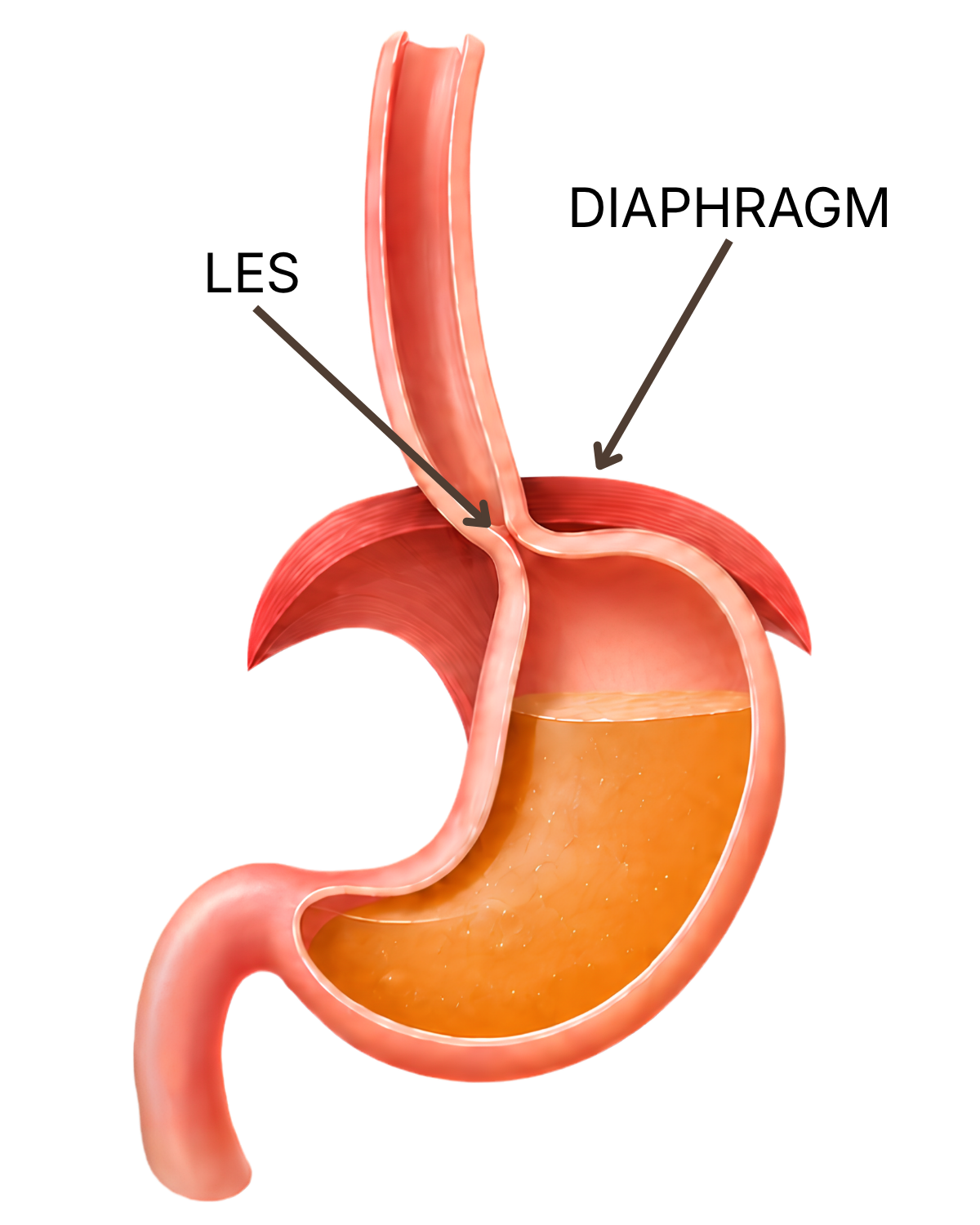
When the diaphragm is weakened, the lower oesophageal sphincter (LES) gets less support and may not close as tightly. This allows stomach acid and other stomach contents to move up into the oesophagus more easily.
Seal weakens → acid risesLump in throat
A hiatal hernia can affect the function of the oesophagus and throat. This can cause a cramping sensation or the feeling of a lump in the throat.
Throat & Oesophagus afffected → Lump sensationMucus in throat
When stomach acid reaches the oesophagus or throat, it can irritate the mucous membranes and trigger increased mucus production. This can lead to thick mucus and frequent throat clearing.
ACID IRRITATES → MORE MUCUSHeartburn
When the diaphragm is weakened, the lower oesophageal sphincter may not close as tightly. Stomach acid can then leak into the oesophagus and cause the burning sensation known as heartburn.
ACID LEAKS UP → heartburnDifficulty swallowing
With a hiatal hernia, the position and function of the throat and oesophagus can be affected, making it harder for food to pass down to the stomach. This can be particularly noticeable when swallowing solid or dry foods.
Throat & Oesophagus afffected → swallowing difficultiesSnoring
When the muscles in the throat and soft palate are weakened, the airway can become narrower during sleep. The soft palate can then vibrate and create the sound of snoring.
weaker throat muscles → vibration → SnoringEvery condition IQoro addresses
Some of these symptoms, such as belching, gas and chest pain, can have several underlying causes. Seek medical advice if your symptoms are severe or persistent. If you experience sudden or severe chest pain, seek emergency medical help.
Hiatal hernia – a weak diaphragm
Acid reflux
Main symptom
IQoro strengthens the diaphragm to restore the oesophageal seal, stopping stomach acid from leaking upwards.
Mucus in the throat
Main symptom
Irritation of the throat lining can trigger increased mucus production as the body tries to protect and moisten the tissue.
Dry cough and hoarse voice
Main symptom
Stomach acid leaks up from the stomach and irritates the vocal cords.
Oesophagitis – Oesophageal catarrh
Main symptom
Acid reflux can irritate and inflame the mucous membranes, triggering excess mucus, particularly at night or in the morning.
Problems with belching or gas
It can have various underlying causes, including allergies, bacterial infections, digestive issues or a hiatal hernia.
Pain in the chest, behind the ribs and in the back
The stomach pushes away other organs and releases stomach acid that together causes pain.
Snoring – weak muscle upper airway
Snoring
Weak muscles in the soft palate relax too much during sleep, narrowing the airway and causing vibrations that produce snoring sounds.
Sleep apnoea
Weak muscles in the throat can relax too much during sleep, allowing the airway to collapse and temporarily stop airflow, causing obstructive sleep apnoea.
Dysphagia / Swallowing difficulty
Difficulty swallowing food
A fold in the oesophagus can trap food, which may come back up with frothy mucus.
Dysphagia – Swallowing difficulties
There are four main causes, with hiatal hernia being a common one.
Dysphagia after stroke
Swallowing difficulties dysphagia, facial paralysis, speech difficulties, impaired bodily functions, disturbed memory patterns, concentration deficit and learning difficulties.
Dysphagia in MS, Parkinson’s disease and ALS
IQoro can complements physiotherapy with 90 sec of daily training but does not treat the underlying disease.
Cancer and dysphagia
IQoro training after cancer treatment may improve muscle strength and coordination, making speaking, eating and swallowing easier.
Abnormal bite- and jaw development
IQoro can strengthen and improve coordination between facial and oral muscles.
Dysphagia in the elderly
As the body ages, our sensitivity and muscle strength weaken, including in the face, oral cavity, pharynx, esophagus and the inner organs.
Dysphagia in children
Children that breathe through their mouths lose the contact between the rear of the tongue and the soft palate.
Facial paralysis and dysphaiga
Central facial weakness or paralysis (central facial palsy).
Clinically proven.
Scientifically studied.

Invented, made and shipped from Sweden.
17
Scientific articles on IQoro. More ongoing studies
97
%
Participants improved significantly in the studies.
The real issue is muscle function
A weakened diaphragm can allow stomach acid and other stomach contents to move upward — often linked to a hiatal hernia. This is the underlying cause behind most reflux-related symptoms. Everything connects back to this.
The diaphragm supports the seal
NORMAL FUNCTION
Under normal conditions, the diaphragm supports the lower oesophageal sphincter (LES), helping it maintain a tight seal between the stomach and oesophagus. When the diaphragm is strong, this barrier functions effectively.When function weakens, the seal breaks down
WEAK DIAPHRAGM – HIATUS HERNIA
When the diaphragm weakens, it can no longer support the seal effectively.
The upper part of the stomach can slide up through the diaphragm, moving the LES above it and preventing it from closing properly.
This may cause symptoms such as a lump sensation in the throat, mucus, frequent throat clearing, hoarseness or swallowing difficulties.Hiatal hernia causes acid reflux
ACID REFLUX
When part of the stomach slides up through the diaphragm opening, the LES loses support and may no longer close properly.
This creates a swinging-door effect, allowing stomach contents and acid to flow back into the oesophagus.Function can be restored
RESTORED FUNCTION
Unlike acid suppression, neuromuscular training targets the muscles directly — building strength and coordination over time.
The goal is to restore function, not mask symptoms.
This is a training session
IQoro works by placing it between your lips and teeth and pulling outward. This triggers a reflex-driven neuromuscular chain that activates muscles from the lips all the way down to the diaphragm.
Step 1
Place IQoro inside your lips, in front of your teeth.
– Hold IQoro between your index and middle fingers.
– Sit or stand steadily and look straight ahead..
– Press your lips firmly against the handle. Keep your jaw relaxed and do not clench your teeth.
Step 2
Shape your lips into a smile and pull the device straight out.
– Breath in normally, then hold your breath.
– Pull straight out for 10 seconds while resisting with your lips.
– Do not pull too hard. You should be able to keep your lips in a smiling position.
Step 3
Train for 10 sec, relax for 3 sec. Repeat 3 times.
– Exhale and relax for 3 seconds.
– Repeat twice more, for a total of 3 repetitions.
– Complete 3 training sessions a day, with at least 2 hours between sessions.
Real people.
Real conditions.
-
Dr Eje Åhlander: “I finally got rid of my snoring”
Eje Åhlander, specialist in general medicine, Sweden
Eje first heard about IQoro through an acquaintance who told him that the neuromuscular training could help with snoring. He decided to try the method and was surprised by how quickly he noticed a result.
-
Ulla’s swallowing difficulties disappeared and her reflux and snoring improved
Ulla, Sweden
Food became stuck in my throat countless times. I also snored so loudly that it wasn’t always easy for my husband to sleep beside me
-
Klara’s swallowing improved and her snoring disappeared with IQoro
Klara Abrahamsson
They ordered an IQoro immediately. Klara was initially sceptical and trained irregularly, but small improvements motivated her to follow the instructions consistently.
-
Eine’s speech and swallowing improved with IQoro after a stroke
Eine Sellman, Sweden
Her speech gradually returned, her swallowing ability improved markedly and the muscles in her face became stronger. As an additional result, Eine also reported that she stopped snoring.
-
Roland snored less and reported no sleep apnoea for a long time
Roland Lönnber, Eva Råbom
It exceeded my expectations. I snore markedly less, and I haven’t had any sleep apnoea for a long time
-
Gary went from ten years of reflux to rarely experiencing discomfort
Gary Sizer
Gary was initially sceptical and considered the product expensive. He now rarely experiences reflux-related discomfort.
-
Eva stopped snoring after around two months with IQoro
Eva Hjalmarsson, Gothenburg, Sweden
Two months after Eva began training, she went on a skiing holiday with her children. To her relief, they confirmed that she had stopped snoring.
-
Beverley’s loud snoring was almost gone after 3–4 weeks with IQoro
Beverley D’Silva, United Kingdom
Beverley searched for a way to reduce her snoring without relying on medication or surgery. During her research, she found IQoro and began training for a total of 90 seconds each day.
-
Berith’s daily regurgitation disappeared after training with IQoro
Berith Sjöberg, Stockholm
A doctor diagnosed Berith with a hiatal hernia and told her that medication was the only available option. After a few weeks of regular training, Berith noticed a clear difference.
Time to first improvement?
Percentage of patients experiencing first improvement over time.
| Time to first improvement | Patients |
|---|---|
| No Improvement yet | 16% |
| Less than 1 month | 15% |
| u003c 1 – 2 month | 48% |
| u003c 1 to 3 – 5 months | 75% |
| u003c 1 to 6 -8 months | 82% |
| +9 months | 84% |
IQoro winner of the Bionow Product of the Year Award
“The winning product can reduce the need for surgery and medication, thus making a significant difference.”

★★★★★
Over 2.000 verified 5-star reviews
NHS
IQoro is available on prescription in the UK on the NHS
You’re covered
by our guarantee
when you buy IQoro at iqoro.com
The results guarantee is automatically included when you buy IQoro from iqoro.com – there is nothing to register.
Train for 6 months – if your symptoms have not improved, claim a refund for your IQoro.
To use the results guarantee, you must:
- Purchase IQoro directly from iqoro.com
- Train according to the manual for 6 months
- Contact us after 6 months and arrange your return within 9 months of purchase
An innovation
based on more than
20 years of research
An all-Swedish innovation
IQoro is a Swedish innovation. The product is manufactured in Nyköping and shipped from our warehouse in Hudiksvall.
State-funded research proves the effect
Training with IQoro is an effective treatment. This is supported by several internationally published studies. 97% of study participants showed improvement.
The research has been conducted by multidisciplinary research teams at Swedish universities, funded by government grants and research foundations.
Common questions
IQoro
Treatment
IQoro works alongside your existing treatment.
Most users start IQoro while continuing their prescribed medication. As diaphragm function improves over time, many are able to reduce medication — in consultation with their doctor.
Never stop prescribed medication without medical guidance. IQoro is a training device — not a replacement for medical care.
What users typically experience
Start IQoro alongside current medication
Noticeable symptom improvement within 6–8 weeks
Discuss medication reduction with doctor as function improves
Many users reduce or stop medication at 3–8 months