Email: How your symptoms are caused by a hiatus hernia

A hiatus hernia can lead to many different symptoms, but the underlying cause is weakened musculature. It is possible to get rid of a hiatus hernia without medication or surgery.
We will come to how it is possible to treat a hiatus hernia easily without contact with healthcare and, moreover, only requires a simple daily routine. But let’s start from scratch with what a hiatus hernia actually is.
There are a number of common symptoms of a hiatus hernia such as:
- heartburn
- acid reflux
- difficulty swallowing (solid consistencies)
- feeling of a lump in your throat
A hiatus hernia does not mean that you have a disease or an injury, but that the musculature is weakened.
The weakening allows the stomach to slide up uncontrollably through the hole found in the diaphragm of the oesophagus. When it does, two things happen:
- Corrosive stomach acid can leak up into the oesophagus
- The oesophagus loses its anchoring in the stomach
It is the root cause of all the symptoms that you graded when you did the self-test online (if you haven’t done it yet, you can start the self-test here).

Treatment of the underlying cause
The underlying cause of the problems is thus weakened musculature. Musculature becomes stronger by exercising, that is hardly news.
On the other hand, this is about the internal musculature that could not be accessed previously. Not muscles that you affect solely by will, such as an arm or a leg.
But with the innovation IQoro, this has now become possible. By using the natural swallowing process, you can get these inner muscles to work.
It’s no more exhausting than brushing your teeth.
By regularly activating the musculature, it becomes progressively stronger, which means that the problems decrease and eventually disappear completely.
Exercising may sound like hard work, but it is no more strenuous than brushing your teeth and also takes significantly less time.
We will tell you more about this later, but thought we would start by explaining what a hiatus hernia actually is.
Having a hiatus hernia is common
At least two out of ten people are estimated to have a hiatus hernia, but there is a large number of unreported cases because not everyone seeks care for their problems. You can have suffer as a child, adult or elderly person. You can be otherwise be fully fit and healthy.
It is important to know what a hiatus hernia is in order to understand what you can do about it. The diaphragm plays a central role in what we will go into later.
The diaphragm is a large, thin and very powerful muscle that partitions the upper body in the middle, just below the chest cavity. It is there to separate the chest cavity from the abdominal cavity.
In the video, specialist nurse Charlotte Pålsson explains what a hiatus hernia is.
This is what it looks like when everything is as it should be
The oesophagus runs from the pharynx, down through a hole in the diaphragm and is anchored to the stomach, which is located under the diaphragm.
When everything works as it should, this is the natural position of the stomach.
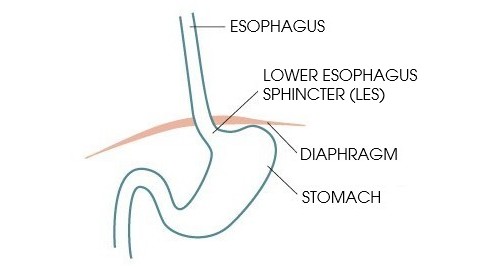
Sometimes the upper part of the stomach needs to slide up through the hole in the diaphragm in order for the stomach to open. This occurs when we vomit or burp.
After that, the stomach slides down again in a controlled manner and then the oesophageal sphincter closes tightly so that the corrosive stomach acid, food and other contents do not leak out of the stomach.
In the position under the diaphragm, the upper oesophageal sphincter acts as a trapdoor where food and liquid make their way into the stomach, but it closes in the other direction.
This is how it works when the musculature is strong and everything is as it should be. Problems arise when the diaphragm does not have the energy to do the job.
Weakened musculature create problems
If the musculature around the hole in the diaphragm (hiatus canal) is weakened, it becomes difficult for the diaphragm to control the position of the stomach.
This means that the stomach can slide up through the hole when it is not supposed to. As often as the stomach slides up, the bothersome symptoms also occur. The longer the time that passes, the more the diaphragm weakens.

This explains why the problems come and go in the beginning and are then perceived as more constant over time.
The weakened diaphragm leads, among other things, to two things, which in turn cause various problems.
1. Stomach acid leaks out
When the stomach ends up above the diaphragm, the oesophageal sphincter loses the function of a trapdoor (which only opens in relation to what is going into the stomach) and turns into a revolving door instead.
This means that the strong, corrosive, stomach acid can leak into the oesophagus – which is not adapted to receive it. It can then cause burning, stinging and an irritating feeling in the upper part of the stomach or cause heartburn or acid reflux.
The oesophagus protects itself against stomach acid with thick phlegm
The oesophagus protects itself from the acid attack by forming thick secretions and phlegm. The excess can come up in the mouth as bubbly chewy saliva that needs to be spat out.
As with heartburn or acid reflux, many people with a hiatus hernia experience more problems in the evening or morning. The reason is that the pressure increases on the stomach when we lie down and the stomach slides up more easily and ends up in the wrong position.

Stomach acid can also spill over into the trachea, leading to an irritating dry cough, sore throat and sometimes respiratory problems (often confused with asthma). The throat can become susceptible to infections when it is constantly irritated by the stomach acid.
There are a number of additional symptoms, but the most common ones are addressed here.
2. Folding oesophagus
The oesophagus, as we mentioned before, is anchored to the stomach, which helps it to remain stretched as a downpipe. When the stomach slides up, the anchorages loosen and the oesophagus folds like a vacuum cleaner hose.
Food can get stuck on its path through the folded tube. The body senses that the food is stuck and on impulse the oesophagus is cleared of the pieces of food – whereupon you can get food residue in your mouth some time after meals, or in the worst case as severe vomiting attacks with thick bubbly phlegm and stomach acid.

Have you experienced a lump in your throat that, no matter how much you clear your throat, doesn’t seem to go away?
With a compressed oesophagus, the upper pharyngoesophageal segment (PES), which is supposed to open the entrance to the oesophagus, can find it difficult to relax and open up the entrance properly.
It convulses and only a narrow passage opens. Liquid slips past nicely, but firmer consistencies like dry meat, chicken, or rice find it harder to pass.
These experiences are unpleasant and can lead to anxiety
This is often experienced as a feeling of a lump in the throat, as if there is an obstruction. Food residue that gets stuck in the pharynx above the muscle can easily fall into the airways, get stuck in your throat and cause coughing at meal times.
These experiences are both unpleasant and can lead to anxiety if you do not understand what it is due to.
Anyone who has swallowing difficulties due to a hiatus hernia may need more liquid to be able to swallow.
Summary and next steps
Having a hiatus hernia means that you have musculature that is simply not strong enough to be able to perform important tasks in the body. In other words, a hiatus hernia is not an illness that will heal.
In order for muscles to become stronger, they must be given a chance to work. Just like with regular strength training, this takes time.
While waiting for the training of your inner muscles to produce results, you may need to reduce the symptoms of your hiatus hernia in the short term to feel good, which you can do in different ways.
Now you know what happens in the body and why a hiatus hernia can lead to various symptoms that, for someone without that knowledge, do not seem to have a connection.
You also know that the root cause is a weakened musculature, which can actually be trained with the help of IQoro.
Get started right away

Order IQoro from our online store and get started at home yourself.
Our customer support will be happy to answer your questions on 01229 444 823. You can also order over the phone.